

Master Your Money, Secure Your Future
Expert advice on personal finance, investing, and wealth building strategies tailored for India.

Money, Stress, and the Workplace: Why Financial Literacy Belongs in Your Wellness Strategy
Every year, conversations about workplace wellness circle back to the same blind spot: mental health programs, gym memberships, meditation apps — and almost nothing that addresses one of the biggest sources of stress employees actually carry into work every day. Money.
Only 27% of Indian adults are financially literate, according to the NCFE's 2019 Financial Literacy and Inclusion Survey — the most recent national benchmark of its kind. That's not a gap in a few unlucky households; it's the baseline for most of the workforce walking into offices across the country, including yours. And unlike the general wellness perks companies have gotten comfortable offering, financial stress doesn't stay contained to someone's personal life. It shows up in absenteeism, in disengagement, in the employee who's mentally somewhere else during a 3pm meeting because they're doing rent math in their head.
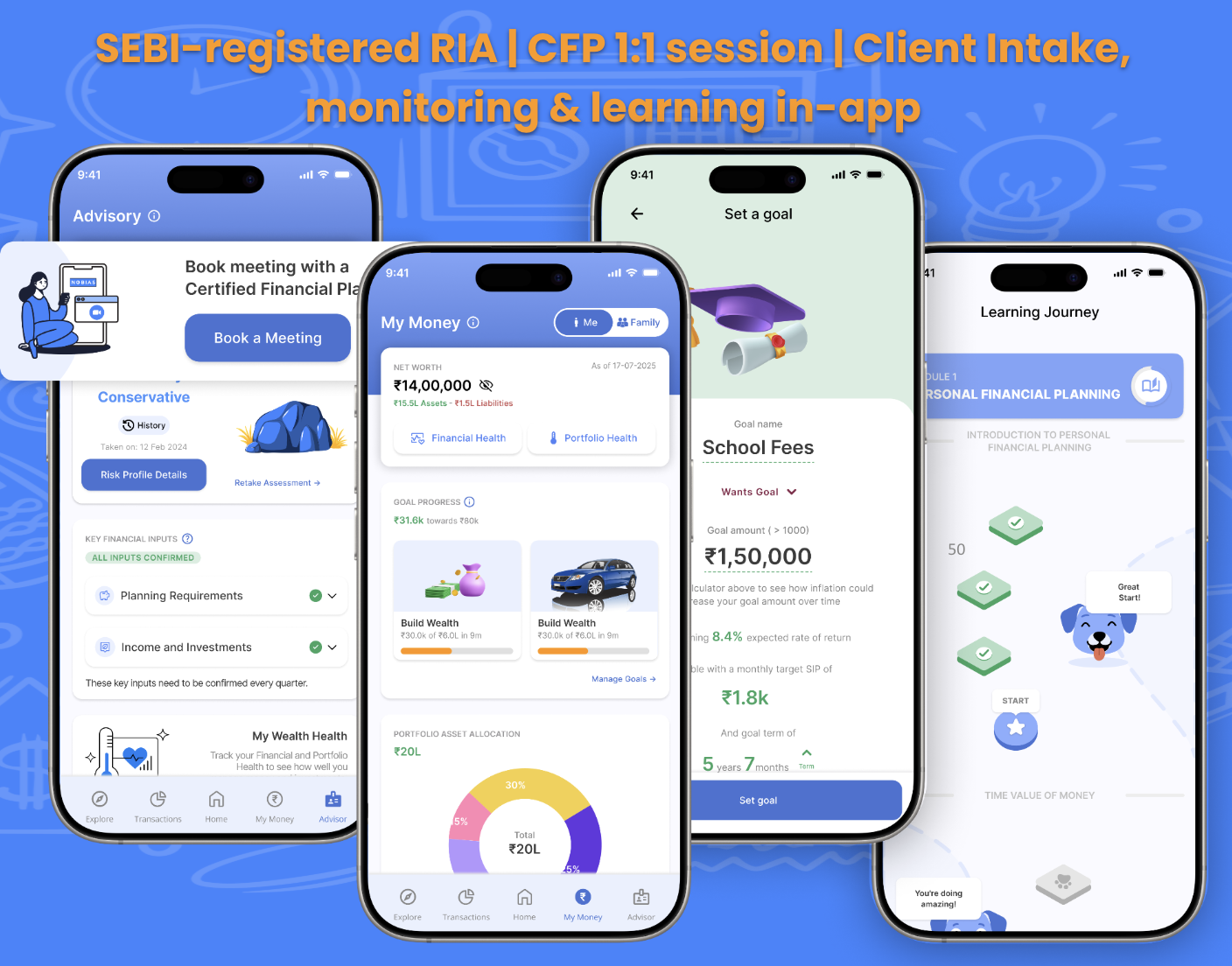
Nobias Artha Review 2026: Is It Worth It for Young Indians?
If you're a 25–35 year old professional in India, you've probably run into the same wall everyone your age runs into: you're earning real money for the first time, you know you should be doing something smarter with it than letting it sit in a savings account, and every "advisor" you talk to seems to be selling you something. A relationship manager at your bank. An uncle who's also an LIC agent. A YouTube channel sponsored by the very broker it's recommending.
Nobias is trying to be the alternative to all of that. Here's an honest look at where it stands, across the things that actually matter to someone in this age group deciding whether to trust it with their money.
Client, Customer, or User?
Google Maps is free. Satellites, data centers, engineers — none of that is free. So who's paying? Not you. You've never given Google a rupee for it.
That's because you're not the customer. You're the "user" — a nicer word for "the thing being sold" to whoever actually pays: advertisers.
You are not being served. You are being served up — Google's version of a drug user, lured in and kept hooked for free.
Client. Customer. User. Only one is legally required to put you first — and it's probably not the one you think.
Here's how to tell which one you actually are 👇
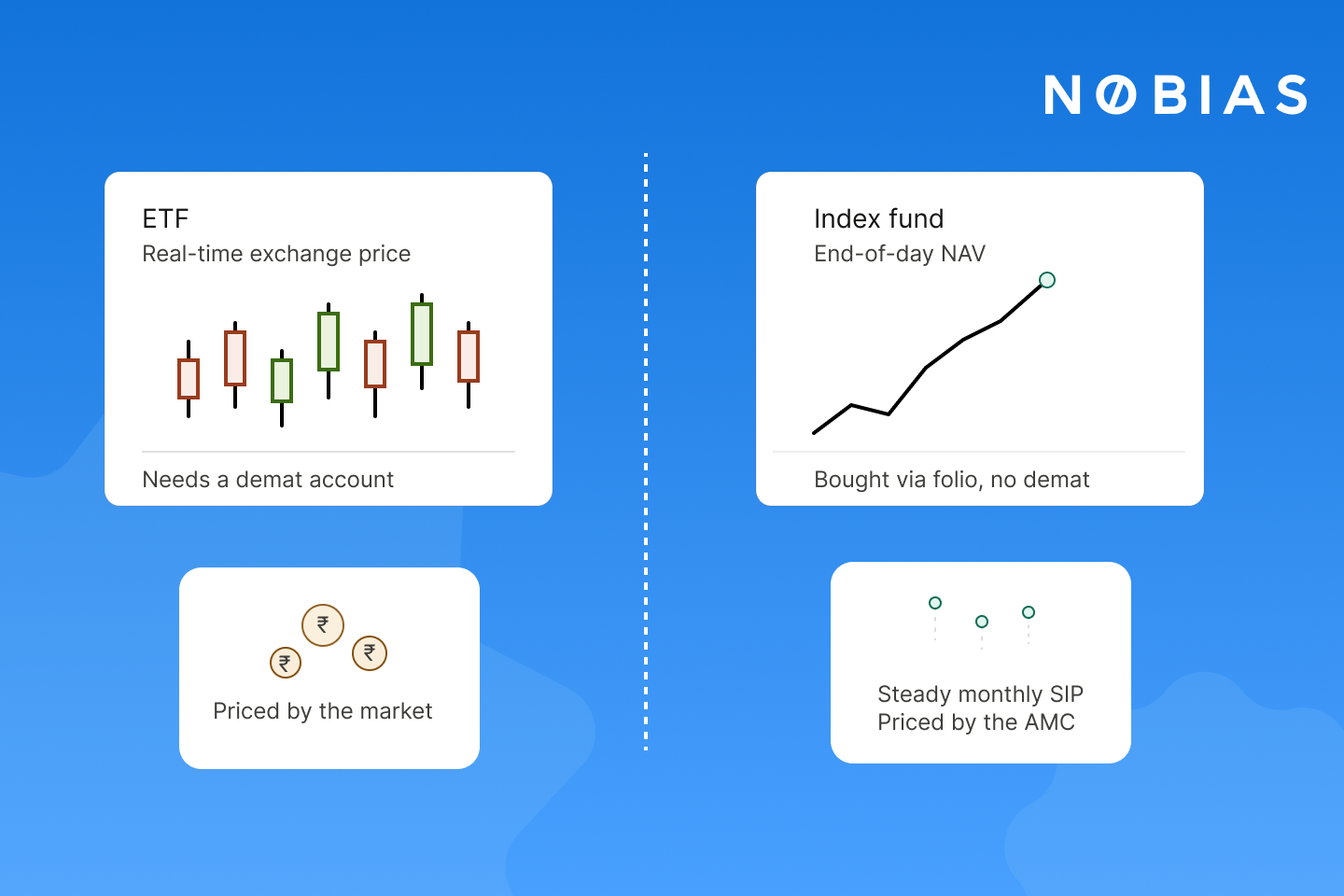
ETF vs Index Fund in India (2026): Why the Cheaper Option Often Costs You More
Passive investing has gone mainstream in India. Retail investors are done paying active fund managers roughly 1.5% a year for performance that frequently trails the index anyway, and the money is following that logic — passive AUM in the Indian mutual fund industry has crossed ₹10 lakh crore over the past five years, per AMFI data.
So most high-earners now agree they want Nifty 50 (or broader index) exposure as the core of their portfolio. The argument that's left is narrower: should that exposure sit in an ETF or an index fund?
The spreadsheet answer says ETF — lower expense ratio, case closed. The real-world answer, once you account for how Indian exchanges actually behave, is messier and usually points the other way for most people.

A Customer's Signature Is No Longer Enough: RBI's New Rules on Bank Mis-Selling, Explained
On June 15, 2026, the RBI issued comprehensive new directions governing how banks advertise, market, and sell financial products. Effective January 1, 2027, these rules apply to all commercial banks except Small Finance Banks, Payments Banks, Regional Rural Banks, and Local Area Banks.
This is not a minor compliance update. It is the most significant regulatory acknowledgement we have seen of a problem that fee-only advisors have been pointing to for years: that the way financial products are sold in India has been systematically designed to benefit the seller more than the buyer.

Why Investors Shouldn’t Worry About Missed Insights
In today’s financial world, investors are constantly bombarded with “market insights,” stock tips, and performance updates. Every chart or social post can make you feel like you’ve missed an opportunity. But chasing every trend doesn’t build wealth staying committed to your financial goals does.

Aggressive Hybrid Funds: Reducing constant Rebalancing
Investing in hybrid mutual funds can be a good option for those looking for a balanced approach to wealth creation. These funds invest in a mix of equity (stocks) and debt (bonds), offering both growth potential and stability. The equity portion aims to provide higher returns over the long term, while the debt portion helps reduce risk and provides regular income. Hybrid mutual funds are suitable for investors who want diversification without having to manage individual stocks and bonds. They are ideal for those with a moderate risk appetite, looking for a combination of capital appreciation and income generation.

How to Decide Which Stocks to Invest In: A 4-Step Guide
Investing in stocks doesn’t have to be complicated, but it does require a thoughtful, structured approach. By following this 4-step process—discovery, research, execution, and monitoring—you can make informed decisions that align with your financial goals while minimizing risk.

Direct vs Regular Mutual Funds : What banks won’t tell you
Not all mutual funds are created equal, and the type you choose—either direct or regular—can significantly impact your financial outcomes. Understanding these differences is critical to avoid being misled by hidden costs and conflicted advice that could reduce your returns.

Think Fast and Slow: Wisdom from Daniel Kahneman for Young Investors
The world of investing can be a whirlwind of excitement and opportunity. Yet, amidst the chaos, lies the challenge of making sound decisions amidst emotional turbulence. Nobel laureate Daniel Kahneman, pioneer of behavioral economics, recognized this struggle all too well. His insights into human cognition shed light on the biases and pitfalls that plague investors, offering a roadmap to navigate the complex landscape of financial markets. As we reflect on his legacy following his recent passing at the age of 90, let's delve into the wisdom he imparted and explore how it can empower young investors in India.

NISM: Types of Mutual Funds, Part 3: Hybrid Funds, Index Funds, ETFs and Solution-Oriented Funds
With a view to bringing in standardization in the classification of mutual funds and to ensure the schemes are clearly distinct from one another, SEBI issued a circular on Categorization and Rationalization of Mutual Fund Schemes in 2017.
Here we describe Hybrid Funds, Index Funds, ETFs and solution-oriented Funds

NISM: Types of Mutual Funds, Part 2: Debt Funds
With a view to bringing in standardization in the classification of mutual funds and to ensure the schemes are clearly distinct from one another, SEBI issued a circular on Categorization and Rationalization of Mutual Fund Schemes in 2017. The objective was to bring uniformity to the characteristics of similar type of schemes launched by different mutual fund houses so that investors could objectively evaluate the schemes chosen for investment.

NISM: Types of Mutual Funds, Part 1: Equity Funds
With a view to bringing in standardization in the classification of mutual funds and to ensure the schemes are clearly distinct from one another, SEBI issued a circular on Categorization and Rationalization of Mutual Fund Schemes in 2017. The objective was to bring uniformity to the characteristics of similar type of schemes launched by different mutual fund houses so that investors could objectively evaluate the schemes chosen for investment.

How to Select Stocks for Long-Term Growth: Your Essential Investment Guide
In today's ever-evolving financial world, understanding how to select stocks for the long term necessitates a deliberate, well-informed, and strategic approach.

Exploring the Dynamics of Long-Term Investment In Stock Market: Benefits and Considerations
Entering the world of stock market investment can be a daunting prospect, especially for those new to the scene. Amidst the rush of headlines, market fluctuations, and the appeal of quick gains, understanding the fundamentals is crucial.

Nobias Thematic Series: Metaverse Magnates
With more than 700 million users online in India, the metaverse holds significant promise. These businesses are engaged in creating and managing virtual worlds, as well as advancing virtual reality and related technologies.
Tata Consultancy Services
Infosys
HCL Technologies
Wipro
LTIMindtree
Tech Mahindra

Nobias Thematic Series: Renewable Energy
In the realm of transformative changes, few are as pivotal as the shift towards renewable energy. As the world grapples with environmental challenges and seeks sustainable alternatives, India is emerging as a beacon of progress in the renewable energy sector, steering the nation toward a cleaner, greener future.

Nobias Thematic Series: Fintech Titans
Financial Technology, commonly known as FinTech, refers to the use of technology to deliver and enhance financial services. The aim of FinTech is to improve and automate the delivery and use of financial services, making them more efficient, accessible, and cost-effective.
The FinTech wave in India is poised to bring about transformative changes, not only in the way businesses manage their finances but also in how consumers interact with and perceive financial services.

Nobias Thematic Series: BlueChip
Bluechips represent established companies with solid financial track records and stable business models. Blue chips tend to be more resistant to market fluctuations.
1. Tata Consultancy Services
2. Reliance Industries
3. HDFC Bank
4. Hindustan Unilever
5. Infosys
6. ITC Limited
7. Asian Paints
Nobias Thematic Series: Artificial Intelligence
Artificial Intelligence (AI) is evolving rapidly, ushering in the most important technological revolution of our lifetimes. We see AI at a point of inflection and expecting ramping AI-based innovation to create new digital consumer use-cases and changes in behavior.
How can investors invest in this cutting-edge technology that is quickly changing society as AI disrupts how we live and work? Machine learning and Artificial Intelligence are at the core of the current technological revolution. Since they can potentially impact almost every primary industry, these technologies, like smartphones, are practically ubiquitous.